For more than twenty years, I painted without calling myself an artist.
Painting was just something I did.
Something I returned to.
Something that made sense to my hands, even when it didn’t always make sense to my head.
I painted between jobs, between responsibilities, between the busyness of life. I didn’t announce it. I didn’t frame it as an identity. I certainly didn’t feel the need to justify it. It was simply there — like breathing, like walking, like thinking with color.
It’s only recently that I’ve begun to look back and realize: that quiet persistence mattered more than I ever gave it credit for.
Practice, Not Permission
As I’ve been working through the life and work of Vincent van Gogh, one theme keeps returning again and again — how much he painted.
Not just the famous works we recognize today, but everything else.
Sketches. Studies. Repetitions. Fields, boots, trees, chairs, skies. The same subjects, over and over, seen slightly differently each time.
Van Gogh didn’t wait to feel “ready.”
He didn’t paint only when inspiration struck.
He practiced. Relentlessly.
That part of his story feels deeply familiar to me.
I’ve never believed my ability to paint came from talent alone. If anything, I believe it came from wanting to paint — and being stubborn enough to keep going back to it, even when it felt awkward, unfinished, or uncertain.
The Painting as a Record of Motion
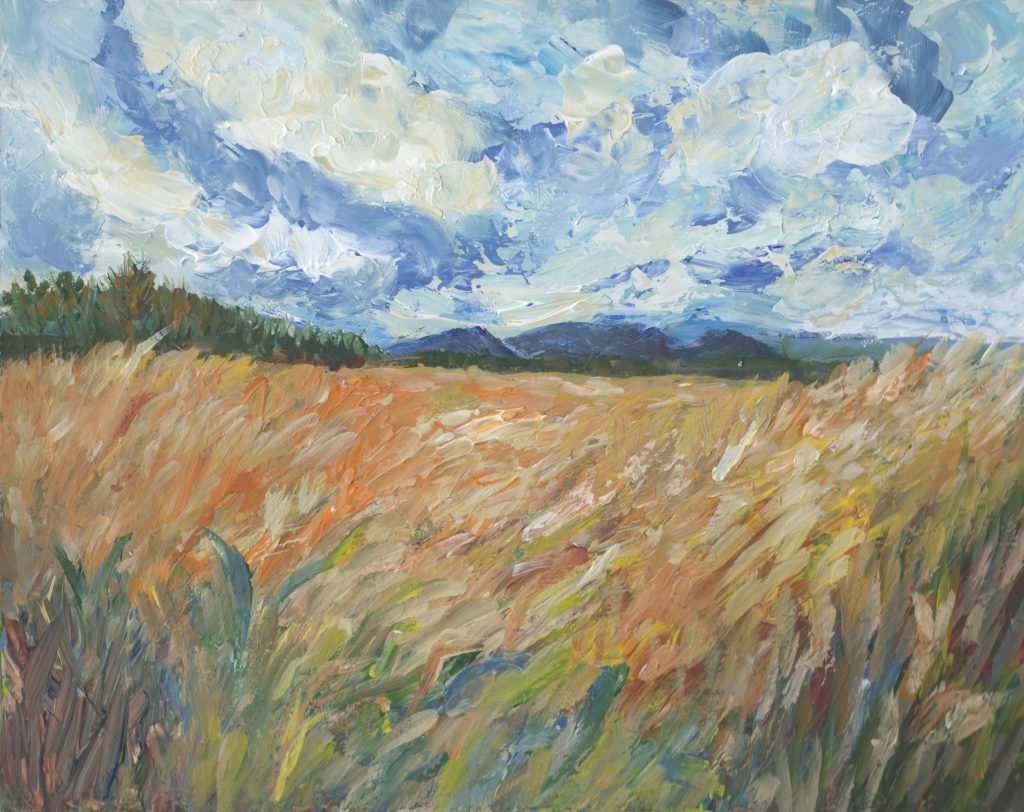
This painting — the one you see here — is less about a place and more about movement.
The field isn’t still.
The sky isn’t calm.
Nothing is trying to be perfect.
Instead, the brushstrokes move the way wind moves through tall grass. The clouds feel worked and reworked, layered with intention and revision. It’s a painting built from motion, from returning again and again to the surface, adjusting, responding, listening.
That’s what years of practice look like.
Not mastery in a single moment — but comfort with the act of showing up.
Wanting It Enough to Keep Going
Van Gogh once wrote about working even when progress felt slow, when understanding came inch by inch rather than all at once. He painted because he needed to see — and the only way to see better was to keep working.
That philosophy has quietly guided my own path.
I didn’t paint because I thought I was exceptional.
I painted because I wanted to.
And because I kept wanting to, I kept practicing.
Over time, the brush became more familiar. Decisions became quicker. Confidence didn’t arrive as a declaration — it arrived as repetition.
Redefining What It Means to Be an Artist
Somewhere along the way, I realized something important:
You don’t become an artist by deciding you are one.
You become an artist by doing the work.
By painting even when no one is watching.
By practicing when the outcome is uncertain.
By returning, again and again, to the simple act of making.
That’s what this painting represents to me — not a finished statement, but a continuation. A moment in a long line of moments where I chose to keep painting.
And that choice, repeated over years, is what finally allowed me to say it out loud:
I am an artist.
Continue the Journey
If Vincent van Gogh’s story resonates with you — the persistence, the searching, the sheer volume of work done quietly and imperfectly — you may enjoy spending more time with it.
Over on Calm Art Studio, I’ve created a four-part, long-form series that traces Vincent van Gogh’s life at a slow, reflective pace. These episodes are designed for listening — while painting, resting, or simply letting the story unfold without urgency.
It’s not about rushing toward masterpieces.
It’s about noticing how a life is built through repetition, effort, and showing up again and again.
Much like painting itself.
You can find the full series on YouTube under Calm Art Studio, and join me there whenever you’re ready to listen, slow down, and continue the conversation between art, practice, and persistence.